
\(\begin{align*}\int\frac{1}{(x²+4)²}dx \end{align*}\) |
Connaissances:
- changement de variable
- une forme \(u²+a²\) au dénominateur implique un changement de variable \(u = a.tan \theta\)
- trigonométrie
- trigonométrie et notation anglosaxonne
- exprimer \(\theta\), \( sin \theta\) et \(cos \theta\) en fonction de \(x\)
|
\(\begin{align*}I & = \int\frac{1}{(x²+4)²}dx \\ Nous avons en bas une forme en \(u²+a²\). ceci nous indique d aller vers un changement de variable trigonométrique du style \(u=tan \theta\). En posant même \(u=2tan \theta\) nous pourrons factoriser par \(2\) et retrouver du \(1+tan² \theta\) que nous saurons gérer. \(\begin{align*} & \begin{cases} x=2tan \theta \\ dx = 2(1+tan² \theta) d \theta\end{cases} \Rightarrow \begin{cases} \theta=tan^{-1}(x/2) \\ dx = 2(sec² \theta) d \theta\end{cases} \\ Il faut maintenant diminuer la puissance de \(cos \theta\) puis primitiver: \(\begin{align*}I & =\frac{1}{8} \int cos² \theta d\theta \\ Comme nous avons \(\theta\), \(sin \theta\), et \(cos \theta\), il est plus facile de dessiner un triangle rectangle pour retrouver ces valeurs en fonction de \(x\)
Il suffit maintenant de remplacer \(\theta\), \(sin \theta\), et \(cos \theta\) par leur valeur pour trouver \(I\) \(\begin{align*}I & = \frac{1}{16} \bigg[ tan^{-1}(x/2) + \frac{x}{\sqrt{x²+2²}}.\frac{2}{\sqrt{x²+2²}} \bigg] +C \\ \[ \boxed{ \begin{align*}I = \frac{1}{16} \bigg[ tan^{-1}(x/2) + \frac{2x}{\sqrt{x²+2²}} \bigg] +C(\in \mathbb R) |
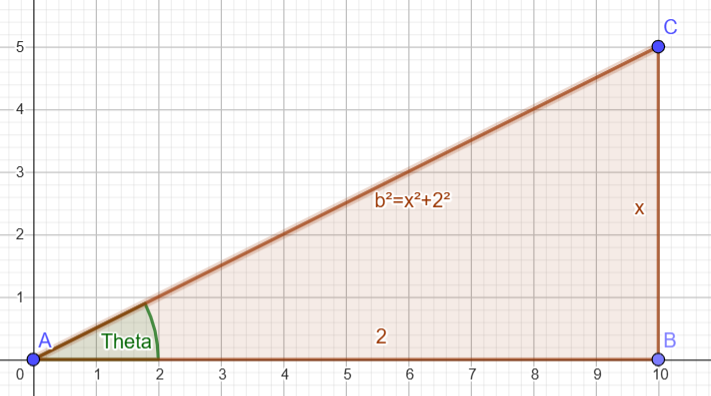 \(\begin{align*} & \theta=tan^{-1}(x/2) \Rightarrow \begin{cases} \text{Hypoténuse } = \sqrt{x²+2²} \\ \\ sin \theta = \frac{x}{\sqrt{x²+2²}} \\ cos \theta = \frac{2}{\sqrt{x²+2²}} \end{cases} \end{align*}\)