1 - Au Lycée

Définition 1:
  • On appelle logarithme népérien d'un réel strictement positif \(x\), l'unique solution de l'équation d'inconnue \(y: e^x=y\). On note cette solution \(ln(x)\) qui se lit: "logarithme népérien de \(x\)."
  • La fonction \(ln\) est la fonction définie sur \(\mathbb R_+^* = ]0;+\infty\) qui a tout réel \(x \gt 0\) associe \(y=ln(x)\)

\(\begin{align*} f : \space & \mathbb {R_+^*} && \to && \mathbb R \\
& x && \mapsto && lnx \end{align*}\)

En conséquence: \(y=lnx\) et \(x \gt 0\) équivaut à \(e^y = x\)

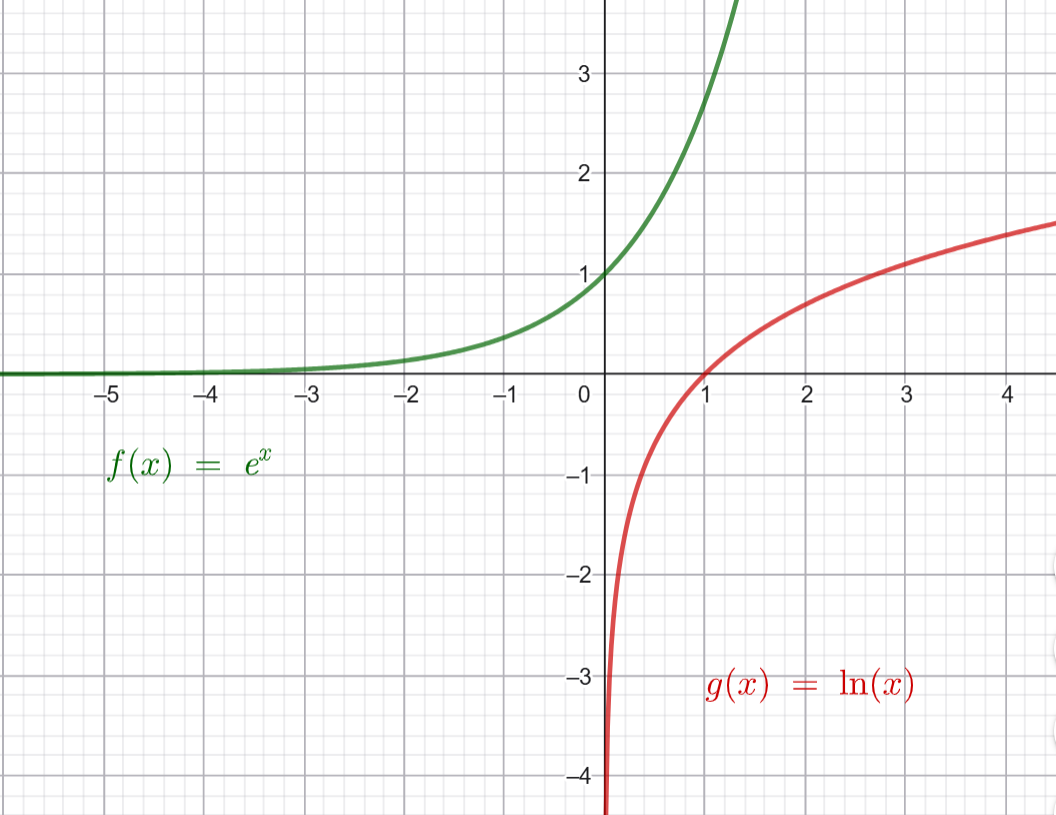
On dit que la fonction \(ln\) est la fonction réciproque de la fonction exponentielle


Représentation graphique:

Propriétés algébrique :

\(\forall x \in \mathbb R_+\) et \(\forall y \in \mathbb R_+\), \(\forall k \in \mathbb Z\)

  • \(ln(xy) = lnx + lny\)
  • \(ln(x^k)=k \times lnx\)
  • \(ln(\sqrt x) = \frac{1}{2}lnx\)
  • \(ln(\frac{x}{y})= lnx-lny\)
  • \(ln(\frac{1}{x})= -lnx\)


Sens de variation :
  • la fonction \(x \mapsto lnx\) est définie, continue et dérivable sur \(\mathbb R_+^* = ]0;+\infty[\) et pout tout \(x \gt 0\), on a \(\big[ lnx \big]' = \frac{1}{x} \)
  • Et comme \(x \in ]0;+\infty[\), alors \(\frac{1}{x} \gt 0\) et \(ln(x)\)  est strictement croissante sur \(\mathbb R_+^*\)


Dérivée et primitives:
  • \( \forall \space x \in ]0;+\infty[\), les primitives de la fonction \(\frac{1}{x}\) sont les fonctions \(x \mapsto lnx +C(\in \mathbb R)\) 
  • Soit u une fonction dérivable sur un intervalle \(I\), et \(u(x) \gt 0\) sur \(I\), la fonction \(f(x) = \frac{u'(x)}{u(x)}\) admet des primitives de la forme \(F(x) = ln(u(x)) + C(\in \mathbb R)\)


Limites:
  • \(\begin{align*} \lim_{x \to +\infty} lnx=+\infty \end{align*}\)
  • \(\begin{align*} \lim_{x \to 0^+} lnx=-\infty \end{align*}\)
  • \(\begin{align*} \lim_{x \to +\infty} \frac{lnx}{x}=0 \end{align*}\)
  • \(\begin{align*} \lim_{x \to +\infty} \frac{lnx}{x^n}=0 \end{align*}\)
  • \(\begin{align*} \lim_{x \to 0^+}x lnx=0 \end{align*}\)
  • \(\begin{align*} \lim_{x \to 0^+} \frac{ln(1+x)}{x} =1 \end{align*}\)


2 - En post bac

On suppose connu les propriétés suivantes:

  • Toute fonction réelle \(f\) continue sur un intervalle \(I\) admet une primitive \(F: I \mapsto \mathbb R\) telle que \(F'=f\)
  • 2 primitives de \(f\) différent d'une constante
  • si \( f: I \mapsto \mathbb R\) est une fonction dérivable, avec une dérivée de signe fixe et qui ne s'annule qu'un nombre fini de fois, alors \(f\) définit une bijection de \(I\) sur l'intervalle \(J=f(I)\) 
  • Si \(f\) est  monotone sur \(I\), alors, a chaque extrémité de \(I\), la fonction \(f\) admet une limite , finie ou infinie
 

La définition vue en post bac est quelque peu différente.

Définition:

La fonction logarithme népérien, notée \(ln\) est l'unique primitive sur \(\mathbb R_+^* = ]0;+\infty[\), qui s'annule en \(1\) de la fonction \(x \mapsto \frac{1}{x}\), ce qui s'écrit aussi:

\(\begin{align*}\forall \space x \in  \mathbb R_+^* \end{align*}\), \(\begin{align*} ln(x) = \int_1^x\frac{du}{u} \end{align*}\)  

 
Proposition:

La fonction logarithme vérifie :  

\(\begin{align*} \forall \space x \in  \mathbb R_+^* \space , \space \forall \space y \in  \mathbb R_+^*  \space , \space ln(xy) = lnx+lny \end{align*}\)


Proposition:
Pour \(x \in ]-1;+\infty\), on a \(ln(1+x) \leq x\) avec égalité si, et seulemnt si,, \(x=0\)